
Heating and Cooling in Hughson, CA
Same-Day Visits
Morning calls get a same-day slot.
Hughson Route
Run from our Modesto base.
Plain Findings
The problem explained first.
Hughson was built in two waves, and they fail differently
Most of Hughson went up in the 2000s, but the town still has a 1950s core around its older streets. That split decides almost everything about a service call. A house from the newer wave is tight, has attic ductwork and is probably on its first or second condenser. A house from the older core has a hall closet, metal ducts and a furnace that has been worked on many times. Same town, same complaint, different visit.
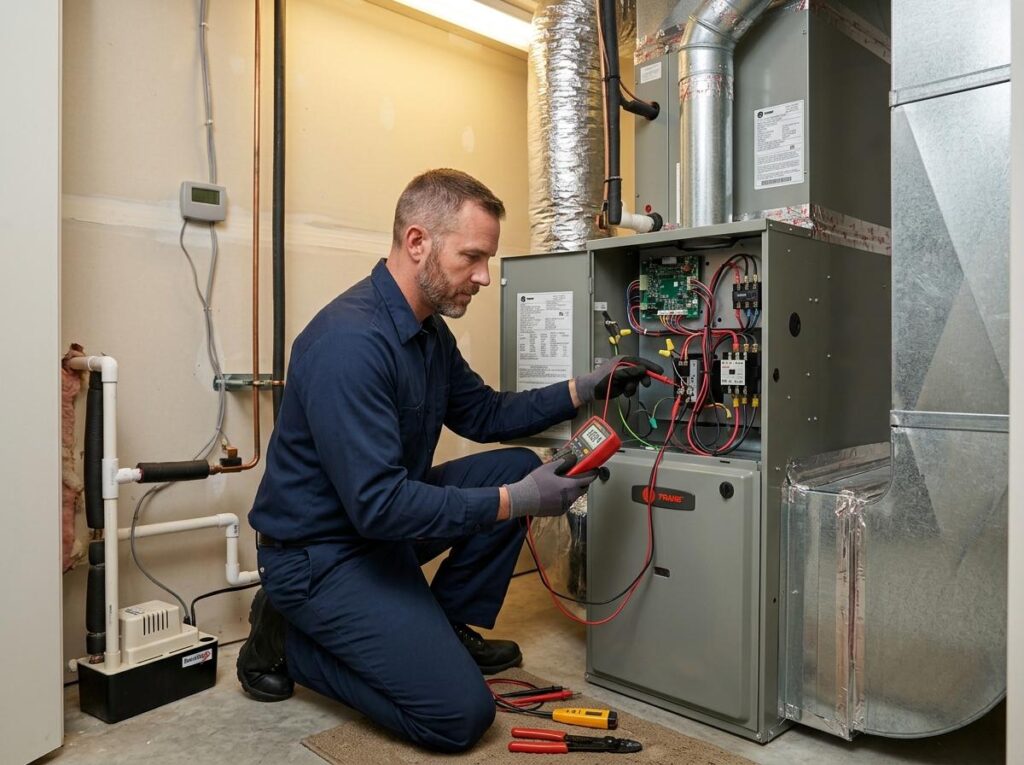
Heating a home in Hughson, CA
Hughson has the most concentrated 2000s housing of the towns in this group, with a small older core still standing beside it. The four blocks below set out what the local numbers mean for the system in your house.
Hughson sits about 124 feet above sea level
Hughson sits at roughly 124 feet above sea level, flat valley floor with no altitude to plan around. At that height a gas appliance draws air at close to sea-level density and should be running on its standard factory orifice set. So if a Hughson furnace burns lazily, lifts off the burner or smells wrong at startup, elevation is not the explanation and never was. The measured causes are the usual five: manifold gas pressure, a dirty or partly blocked burner, a flue with an obstruction, an inducer that is slowing down, and a heat exchanger that has failed. Each one is a gauge reading or a visual check rather than an opinion about the house. A two-stage or modulating furnace adds one more reading, the low-fire manifold pressure, and skipping it is a common reason an intermittent fault never gets found.
Hughson’s housing came in two waves
The Census puts Hughson’s median year built at 1996, but the average hides a sharp split: 34.5% of the housing dates from the 2000s, while 13.5% is from the 1950s and 7.2% predates 1940. Those are two different construction worlds inside one small town. The 2000s houses are tighter, with attic ductwork and modern windows, and their equipment is often original to the build. The 1950s and older houses have closets, metal duct runs and additions that were never part of the original design, and their furnace closets were often sized for a smaller appliance than the one standing there now. Which wave your house belongs to decides what the technician checks first, and it decides which parts are worth carrying on the van.
How Hughson heats its homes
Utility gas is the primary heating fuel in 81.5% of occupied Hughson homes, according to the American Community Survey. Electricity accounts for 17.3%, bottled or tank gas for 1.0% and homes with no fuel used for 0.2%. That gas share is among the highest in this group, which makes the town unusually uniform on fuel even though it is split on age. Three caveats apply. Each home’s primary fuel is counted once. The estimate lags about two years. And electricity is not a synonym for heat pump, since resistance heat is counted in the same line. A gas-heavy town still has electric equipment in it, and the bill is the only reliable clue. What the split cannot tell you is the condition of any single system.
Who serves a Hughson address
Hughson is an incorporated city in Stanislaus County, so a furnace or air-conditioner changeout inside the city limits is permitted through the City of Hughson, with addresses outside the limits falling to the county. On utilities, no single answer covers every address, and rebate eligibility depends on which utility serves the house. That matters more in a town where most homes are on gas, because a program written for electric equipment will not apply to the furnace in the closet. Before you plan around a rebate, check the provider named on the bill and the fuel the appliance actually burns. A changeout also has to match the venting, and in an older Hughson house the flue may be shared or undersized for the new unit.

HVAC services in Hughson, CA
Hughson work divides along the same line as the housing: the 2000s houses and the older core need different first questions.
In the newer wave, the common calls are a condenser that has lost charge, a blower that runs but cannot move air through a long attic duct run, and a furnace that short-cycles on the coldest mornings. We handle AC service and AC installation, and the visit starts with airflow and return sizing, because a tight 2000s house can lose a large share of its capacity before the air reaches a far bedroom.
In the older core, the calls are a furnace that lights and drops out, a blower that moves little air and ductwork that has been extended one room at a time. We handle furnace repair and furnace maintenance, and where the unit is at the end of its life, furnace installation begins with a load check and a venting inspection rather than a like-for-like swap. A 1950s closet rarely fits a modern furnace without some thought about combustion air.
Heat pumps sit between the two. We handle heat pump repair and heat pump installation, and a 2000s Hughson house is often a better candidate for one than an older property, because the envelope and the electrical service are closer to what the equipment needs.
Water heaters and air quality round out the list: water heater repair for a tank that weeps at the base, and indoor air quality work where filtration and returns are the complaint. Neither is a separate trade in a house this size, and both are cheaper to handle on the same visit as the heating call.
Maintenance is the part that gets skipped. A spring visit cleans the outdoor coil, checks the charge and clears the drain before the first hot week. An autumn visit checks the burners, the flue and the heat exchanger before the first cold one. Both are inspections with a written finding, and both cost less than the repair they are meant to prevent. A maintenance visit is also when a failing capacitor or a cracked belt gets caught while it is still a cheap part.
Heating or cooling problem in Hughson?
Why homeowners in Hughson choose us
AC Service Modesto works Hughson from our Modesto base, and the town’s two housing waves are the reason a single script does not work here. A 2000s house and a 1950s house on the same block can need opposite approaches: one wants airflow measured through a long attic run, the other wants combustion air and venting checked in a closet that was built for a smaller appliance. We ask for the year the house was built and the equipment model before the visit, so the right parts and the right gauges are on the van. You get the finding in plain language, the options in the order that fixes the complaint, and no work started before you agree to it. If the honest answer is that the equipment has another season in it, the report will say so.
What a first visit covers
- The complaint reproduced before anything is adjusted
- Gas pressure and flame signal on a furnace call
- Static pressure, filter and return condition
- Refrigerant pressures and airflow on a cooling call
- A written finding before work begins
What a Hughson changeout involves
- A load check rather than a like-for-like swap
- Combustion air and venting in an older closet
- Whether the ductwork can carry the new airflow
- Electrical circuit and disconnect rating
- The City of Hughson permit path
Why this winter matters in Hughson
Hughson’s timing question is set by the 2000s wave. Those houses are now old enough that the original condenser and the original furnace are both reaching the end of their service life in the same few years, and a household that replaces one without looking at the other tends to pay twice. The older core has the opposite problem: equipment that has been repaired several times and is being kept alive one part at a time, which works until the heat exchanger is the part that goes. Neither failure announces itself. A cracked heat exchanger, a seized inducer or a failed capacitor all tend to show up on the first genuinely cold night, with no warning the week before. Booking the assessment in autumn leaves time for the parts of a changeout that cannot be rushed: the load check, the duct inspection, the venting inspection and the city permit.
Frequently asked questions in Hughson
How old are most houses in Hughson?
The median year built is 1996, but the distribution is split: 34.5% of the housing dates from the 2000s, 14.4% from the 1990s and 13.5% from the 1950s, with 7.2% predating 1940. That makes Hughson a town of two construction worlds rather than one. The newer houses are tighter and often have attic ductwork, while the older core has closets and metal ducts, so the year the house was built is the most useful thing to tell us before a visit.
Do most Hughson homes heat with gas?
Yes. Utility gas is the primary fuel in 81.5% of occupied Hughson homes, against 17.3% electricity, 1.0% bottled or tank gas and 0.2% with no fuel used. The Census counts one primary fuel per home and the estimate lags about two years, so the figures describe the housing stock rather than this winter’s installations. The high gas share is why furnace work dominates here, but it does not tell you what a particular house burns; the appliance label and the bill do.
Does Hughson’s elevation affect a furnace?
No. Hughson sits at about 124 feet above sea level, close enough to sea level that combustion air is at normal density and the appliance should be on its standard factory orifice set. There is no altitude conversion to plan for. A furnace that burns poorly here is far more likely to have a gas pressure problem, a dirty burner, a blocked flue or a failing inducer.
Is a 20-year-old furnace in Hughson worth repairing?
Sometimes, and the heat exchanger decides it. If the exchanger is sound and the fault is a single component such as an igniter, a pressure switch or a capacitor, a repair is reasonable. If the exchanger is failing, or the inducer and the control board are both near the end, the money is better spent on a replacement, because repairing one part of a furnace that is failing in three places is how a household pays twice in two winters.
Why does my Hughson furnace short-cycle?
Short cycling means the furnace is satisfying its own safety or temperature limit rather than the house. The usual causes are a restricted filter or a blocked return, a flue that cannot vent properly, an oversized unit that heats the space faster than the blower can distribute the air, or a high-limit switch that is tripping. The fix depends on which one it is, and the only way to tell is to measure airflow and temperature rise rather than replace parts.
Is a heat pump a sensible choice for a Hughson house?
It can be, particularly in the 2000s housing where the envelope is tighter and the electrical service is usually adequate. A heat pump moves heat rather than generating it, so it suits a house with reasonable insulation and ductwork that can carry the airflow. In the older core the panel, the ducts and the insulation often need attention first, and that assessment should come before the equipment choice rather than after.
Serving Hughson and Stanislaus County
Next step for your Hughson home
Call (209) 439-1859 and describe the complaint.
Call (209) 439-1859 and describe the complaint..
Tell us the year the house was built.
Tell us the year the house was built..
We book a same-day or next-day visit where the schedule allows.
We book a same-day or next-day visit where the schedule allows..
Airflow, gas pressure and venting are all checked.
Airflow, gas pressure and venting are all checked..
You choose repair, replacement or a duct assessment.
You choose repair, replacement or a duct assessment..
Work is scheduled around the City of Hughson permit path.
Work is scheduled around the City of Hughson permit path..