
Heating and Cooling in Lathrop, CA
Same-Day Visits
Morning calls get a same-day slot.
Lathrop Route
Run from our Modesto base.
Plain Findings
The problem explained first.
Lathrop is the newest housing stock in this group
Lathrop barely existed as a city before the 1990s. Of the homes standing today, 28.5% went up in the 2000s, 27.2% in the 2010s and another 9.5% in 2020 or later. That changes the work. This is not a town of fifty-year-old furnaces; it is a town of first-generation heat pumps, modern condensers and ductwork that is still the original installation. The failures here are younger, and they cluster around installation quality rather than age.
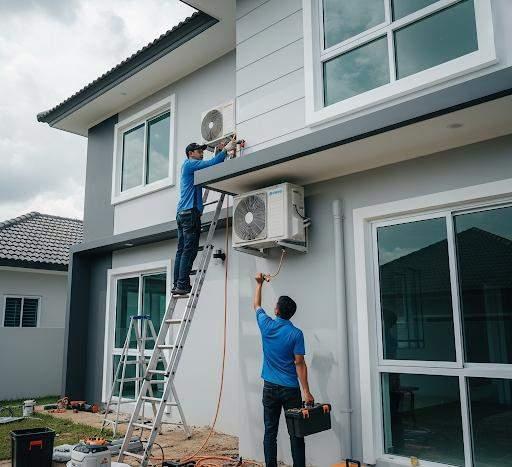
Heating a home in Lathrop, CA
Lathrop is the newest and lowest housing stock in this group, with the highest electric share. The four blocks below set out what the local numbers mean for the system in your house.
Lathrop sits about 13 feet above sea level
Lathrop sits at roughly 13 feet above sea level, the lowest ground of any town in this group and close to the river corridor. Elevation is not a combustion problem at this height: a gas appliance draws air at sea-level density and runs its standard factory orifices, with no altitude conversion involved. What the low, flat ground does affect is moisture. Condensate drains, outdoor units sitting on pads that hold water, and crawl spaces that stay damp all create the same symptom in summer, which is a system that cools poorly and smells musty. Checking the drain and the pad is part of a cooling visit here, and so is checking whether the outdoor unit sits level on ground that shifts.
Lathrop was built after 1990
The Census puts Lathrop’s median year built at 2005, the newest in this group. The distribution is heavily weighted to recent decades: 28.5% from the 2000s, 27.2% from the 2010s, 13.7% from the 1990s and 9.5% in 2020 or later, with only 0.9% predating 1940. That profile has a practical consequence. Almost every system in town is the original equipment from the build, so the second replacement has not happened yet. When a 2005 house loses a condenser, the duct system behind it is also from 2005, and the two are being judged together for the first time. That is why a Lathrop service visit spends as much time on the ducts as on the box.
How Lathrop heats its homes
Utility gas is the primary heating fuel in 67.5% of occupied Lathrop homes, according to the American Community Survey. Electricity accounts for 26.1%, solar for 3.4%, bottled or tank gas for 1.4%, wood for 0.4% and homes with no fuel used for 1.0%. The electric share is the highest of the towns in this group, and the solar figure is the highest too, which together point at a housing stock where heat pumps and photovoltaic systems arrived early. Three caveats apply. Each home’s primary fuel is counted once. The estimate lags about two years. And electricity is not a synonym for heat pump, because resistance heat is counted in the same line. In practice one Lathrop heating call in four starts with electric equipment.
Who serves a Lathrop address
Lathrop is an incorporated city in San Joaquin County, so a furnace or air-conditioner changeout inside the city limits is permitted through the City of Lathrop, with addresses outside the limits falling to the county. On utilities, no single answer covers every address, and rebate eligibility depends on which utility serves the house. Both checks matter more in a town this new, because a changeout in a 2005 or 2015 house is often a first replacement, and the equipment being removed may be on a different fuel from the one a rebate is written for. The age of the house is the other half of that check, since a first replacement can also mean a first look at the electrical panel.

HVAC services in Lathrop, CA
Lathrop work is mostly first-replacement work, which is a different job from repairing a furnace that has been fixed four times.
The common calls are a heat pump that cannot hold temperature on a cold morning, a condenser that trips a breaker, a coil that ices over and a blower that runs but moves little air down a long attic run. We handle heat pump repair, AC service and AC installation, and the visit starts with airflow, charge and defrost rather than a parts swap.
Heating in the newer houses is often electric. Where a system is being replaced, heat pump installation is usually a better answer than putting resistance heat back in, because the house was built tight enough for a heat pump to perform. In the gas-heated houses the calls are the familiar ones, and we handle furnace repair, furnace maintenance and furnace installation with the same load check and venting inspection.
The moisture question is local. A house at 13 feet on flat ground has a condensate drain that has to actually drain, an outdoor unit that should not sit in standing water and a return path that should not pull from a damp crawl space. Those are cheap things to check on a cooling visit and expensive things to discover after a ceiling stain. A drain pan that holds water is also the usual source of the musty smell people blame on the ducts.
Maintenance is the part that gets skipped, and in a town this new it is also the part that protects the warranty position. A spring visit cleans the outdoor coil, checks the charge and clears the drain before the first hot week. An autumn visit checks the burners or the reversing valve and confirms the heat works before the first cold one. Both are inspections with a written finding rather than a parts swap, and both cost less than the repair they are meant to prevent. On a house this young, the record also matters at resale.
Water heaters and air quality round out the list: water heater repair where a tank weeps at the base, and indoor air quality work where filtration and returns are the complaint. Both are cheaper to add to a heating or cooling visit than to book separately.
Heating or cooling problem in Lathrop?
Why homeowners in Lathrop choose us
AC Service Modesto works Lathrop from our Modesto base, a run down the valley rather than a special trip. The local reason homeowners call is the age of the stock: most of Lathrop was built after 2000, so the equipment is young but the installation decisions behind it are now being tested. A 2005 condenser on 2005 ductwork, a heat pump sized for a tighter envelope and a return that is smaller than the load all show up here. We ask for the year the house was built, the equipment model and whether the house heats with gas or electric before the visit, so the technician arrives with the right gauges. You get the finding in plain language, the options ranked by what fixes the complaint, and no work started before you agree to it.
What a first visit covers
- The complaint reproduced before anything is adjusted
- Charge, airflow and defrost on a heat pump call
- Refrigerant pressures and drain condition on a cooling call
- Condensate routing on low, flat ground
- A written finding before work begins
What a Lathrop changeout involves
- A load check rather than a like-for-like swap
- Whether the original ductwork can carry the airflow
- Line-set length and routing on a heat pump
- Electrical service and disconnect rating
- The City of Lathrop permit path

Why this winter matters in Lathrop
Lathrop’s timing question is about the first replacement, not the last. A house built in 2005 is at the age where the original condenser and the original heat pump reach a decision in the same few years, and the equipment that comes out is usually the equipment the house was designed around. Getting that decision right means measuring the house rather than matching the label on the old unit. The 2010s houses are close behind, and the failures look the same: a capacitor that opens, a reversing valve that sticks, a defrost board that stops, a blower that seizes. Most of those are installation and commissioning questions as much as age questions, which is why the first visit starts with measurements rather than a parts list. None of them is gradual. Each one turns a comfortable house cold on the first genuinely cold night, usually with no warning the week before. Booking the assessment in autumn leaves time for the load check, the duct inspection and the city permit.

Frequently asked questions in Lathrop
How old are most houses in Lathrop?
The median year built is 2005, the newest of the towns in this group. Just 0.9% of the housing predates 1940, while 28.5% dates from the 2000s, 27.2% from the 2010s, 13.7% from the 1990s and 9.5% from 2020 or later. That means almost every system in town is original to the build, and most replacements here are first replacements rather than second ones.
Do most Lathrop homes heat with gas?
Utility gas is the primary fuel in 67.5% of occupied Lathrop homes, against 26.1% electricity, 3.4% solar, 1.4% bottled gas, 0.4% wood and 1.0% with no fuel used. The electric and solar shares are the highest in this group, which fits a housing stock built mostly after 2000. The Census counts one primary fuel per home and lags about two years, so the figures describe the housing stock rather than this winter. What they cannot tell you is the condition of any single system.
Does Lathrop’s low elevation affect a furnace?
Not for combustion. At about 13 feet above sea level, the air a furnace draws is at sea-level density and the appliance should be on its standard factory orifice set, with no altitude conversion involved. What the low, flat ground does affect is moisture: condensate drains, outdoor pads and damp crawl spaces are the local issues, and they show up as cooling problems rather than heating ones.
Which city permits a changeout in Lathrop?
Lathrop is an incorporated city in San Joaquin County, so a changeout inside the city limits is permitted through the City of Lathrop, with addresses outside the limits falling to the county. Confirming the jurisdiction before work is scheduled matters because the permit sets the inspection sequence, and a heat pump changeout may also involve electrical work that is inspected.
Should I replace a working 2005 air conditioner in Lathrop?
Not automatically. A 2005 system that still holds charge, keeps the house comfortable and passes an airflow check can keep running for a while yet. The decision turns on the heat exchanger or the coil, the refrigerant type, and how the ducts are performing, not on the calendar alone. What should trigger a closer look is a repair that costs a large share of a replacement, or a second repair in the same season, or a refrigerant that is no longer being produced.
Why does my Lathrop heat pump run constantly in winter?
A heat pump running long cycles in cold weather is normal, because it moves heat rather than generating it and delivers less capacity as the outdoor air cools. Constant running becomes a fault when the house is still cold, when the auxiliary heat never engages, or when the system is short-cycling instead. Checking charge, airflow and the defrost cycle separates normal cold-weather behaviour from a real problem.
Serving Lathrop and San Joaquin County
Next step for your Lathrop home
Call (209) 439-1859 and describe the complaint.
Call (209) 439-1859 and describe the complaint..
Tell us the year the house was built and what it burns.
Tell us the year the house was built and what it burns..
We book a same-day or next-day visit where the schedule allows.
We book a same-day or next-day visit where the schedule allows..
Charge, airflow and the condensate drain are checked.
Charge, airflow and the condensate drain are checked..
You choose repair, replacement or a duct assessment.
You choose repair, replacement or a duct assessment..
Work is scheduled around the City of Lathrop permit path.
Work is scheduled around the City of Lathrop permit path..