
Heating and Cooling in Escalon, CA
Same-Day Visits
Morning calls get a same-day slot.
Escalon Route
Run from our Modesto base.
Plain Findings
The problem explained first.
Escalon's biggest building decade was the 1980s
Most of Escalon was built in a single stretch: 27.9% of the housing dates from the 1980s, with a second wave in the 2000s. That makes the town unusually easy to read. The 1980s houses are now on their second or third furnace, often with the original ductwork, and the 2000s houses are on equipment that is just old enough to start failing. Which one you live in decides what the first visit is for.
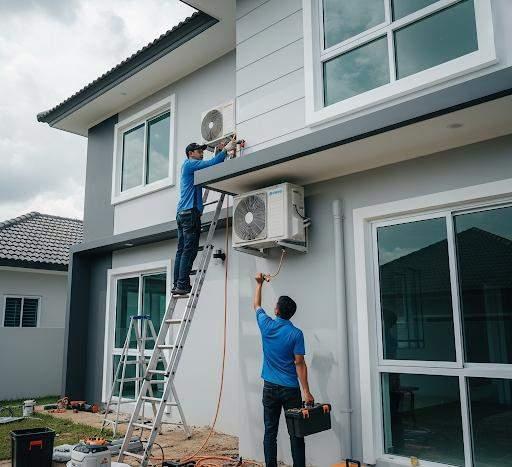
Heating a home in Escalon, CA
Escalon is a compact city in San Joaquin County with one dominant building decade and a smaller newer wave beside it. The four blocks below set out what the local numbers mean for the system in your house.
Escalon sits about 115 feet above sea level
Escalon sits at roughly 115 feet above sea level, on flat valley ground with no elevation to plan around. At that height a gas appliance draws combustion air at close to sea-level density and should be running its standard factory orifices, with no high-altitude conversion anywhere in its history. So when an Escalon furnace burns unevenly, lifts off the burner or leaves a smell at startup, the cause is one of the measurable ones: manifold gas pressure, a dirty burner, a flue with an obstruction, a slowing inducer, or a heat exchanger that has failed. Each is a gauge reading or a visual check, so the diagnosis does not depend on guessing about the house. A two-stage furnace adds a low-fire pressure reading to that list, and skipping it is a common reason a fault looks intermittent.
Escalon was built mainly in the 1980s
The Census puts Escalon’s median year built at 1987, and 27.9% of the housing dates from the 1980s, with 19.8% from the 2000s and 16.8% from the 1990s. Just 10.9% is from the 1970s and 5.7% predates 1940. That is a town built in one long stretch rather than a patchwork, and it means the housing shares a set of habits: a closet or garage furnace, a metal trunk line, a hallway return and a panel from the same era. When one house on a street needs a blower, several usually do, because the parts were installed within a few years of each other. Additions are common on these houses too, and a room added without a supply register is one reason a bedroom never gets comfortable.
How Escalon heats its homes
Utility gas is the primary heating fuel in 80.6% of occupied Escalon homes, according to the American Community Survey. Electricity accounts for 16.2%, wood for 1.5%, solar for 1.3% and bottled or tank gas for 0.4%. The gas share is high even by valley standards, so most Escalon calls begin at a gas furnace. Three caveats apply to the split. Each home’s primary fuel is counted once. The estimate lags about two years. And electricity is not a synonym for heat pump, because resistance heat is counted in the same line. Solar here is a primary heating fuel for a small number of homes, not a description of the panels a household may have added later. What the split cannot tell you is the condition of any single system.
Who serves an Escalon address
Escalon is an incorporated city in San Joaquin County, so a furnace or air-conditioner changeout inside the city limits is permitted through the City of Escalon, with addresses outside the limits falling to the county. On utilities, no single answer covers every address, and rebate eligibility depends on which utility serves the house. Both facts are worth confirming before work is scheduled, because the permit sets the inspection sequence and a fuel or venting change is part of what gets inspected. That check is more than paperwork in a town this compact, since a short move can cross from city to county jurisdiction without changing the street name. The utility side is separate from the permit side, so the two checks do not answer the same question.

HVAC services in Escalon, CA
Escalon work starts with the decade the house belongs to, because the town’s 1980s stock and its 2000s stock fail in different places.
In the 1980s houses, the common calls are a furnace that lights and drops out, a blower that moves little air, a heat exchanger at the end of its life and ductwork that has been patched over the years. We handle furnace repair and furnace maintenance, and where the unit is past saving, furnace installation begins with a load check, a venting inspection and a look at whether the closet has enough combustion air for a modern appliance.
In the newer houses, the calls are a condenser that has lost charge, a coil that ices over, and a blower that cannot push air down a long attic run. We handle AC service, AC installation and heat pump repair, and the visit starts with airflow and return sizing before any equipment is condemned. A frozen coil is usually an airflow problem wearing a refrigerant costume.
Where a changeout is the answer, the ducts deserve the same attention as the box. A 1980s trunk line that has been sealed once and extended twice will not carry the airflow a new unit needs, and a like-for-like swap leaves the far bedroom exactly as cold as before. Sealing the joints and confirming the return path is usually part of the same job, and it is cheaper than discovering the problem after the new equipment is running. We also handle water heater repair and indoor air quality work, both of which are cheaper to add to a heating visit than to book on their own.
Maintenance is the part that gets skipped. A spring visit cleans the outdoor coil, checks the charge and clears the drain before the first hot week. An autumn visit checks the burners, the flue and the heat exchanger before the first cold one, and it is also when a weak igniter or a dirty flame sensor gets caught while it is still a cheap part. Both are inspections with a written finding rather than a parts swap, and both cost less than the repair they are meant to prevent.
Heating or cooling problem in Escalon?
Why homeowners in Escalon choose us
AC Service Modesto works Escalon from our Modesto base, a straight run up the highway rather than a special trip. The local reason homeowners call is the age profile: a town built mostly in one decade has predictable faults, and a technician who knows the 1980s closet furnace and its ductwork arrives with the right parts and the right questions. We ask for the year the house was built and the equipment model before the visit. You get the finding in plain language, the options ranked by what actually fixes the complaint, and no work started before you agree to it. If the honest answer is that the old unit has another season in it, the report will say so rather than sell a replacement. That matters most on the 1980s houses, where the equipment is old but the ductwork is often the real limit.
What a first visit covers
- The complaint reproduced before anything is adjusted
- Gas pressure and flame signal on a furnace call
- Heat exchanger inspection on a 1980s furnace
- Static pressure, filter and return condition
- A written finding before work begins
What an Escalon changeout involves
- A load check rather than a like-for-like swap
- Combustion air and venting in the existing closet
- Whether the original ductwork can carry the airflow
- Electrical service and disconnect rating
- The City of Escalon permit path
Why this winter matters in Escalon
Escalon’s timing question is set by the 1980s wave. Those furnaces have been repaired more than once, and the heat exchangers in them are the same age as the ductwork around them. The 2000s houses are reaching the point where the original condenser and the original furnace both need a decision in the same few years, and a household that replaces one without looking at the other tends to pay twice. Neither failure is gradual. A cracked exchanger, a seized inducer or a failed capacitor all tend to appear on the first genuinely cold night, with no warning the week before. Booking the assessment in autumn leaves time for the parts of a changeout that cannot be rushed: the load check, the duct inspection, the venting check and the city permit.
Frequently asked questions in Escalon
How old are most houses in Escalon?
The median year built is 1987, and 27.9% of the housing dates from the 1980s, with 19.8% from the 2000s and 16.8% from the 1990s. Only 5.7% predates 1940. That concentration means much of the town shares a construction era, so equipment installed in the same decade tends to reach the end of its life in the same decade. The year the house was built is the most useful thing to tell us before a visit.
Do most Escalon homes heat with gas?
Yes. Utility gas is the primary fuel in 80.6% of occupied Escalon homes, against 16.2% electricity, 1.5% wood, 1.3% solar and 0.4% bottled or tank gas. The gas share is high even for the valley, which is why furnace work dominates local calls. The Census counts one primary fuel per home and the estimate lags about two years, so the figures describe the housing stock rather than this winter’s installations.
Does Escalon’s elevation affect a furnace?
No. Escalon sits at about 115 feet above sea level, so combustion air is at normal density and the appliance should be on its standard factory orifice set. There is no altitude conversion to plan for. A furnace that burns poorly here is far more likely to have a gas pressure problem, a dirty burner, a blocked flue or a failing inducer.
Which city permits a changeout in Escalon?
Escalon is an incorporated city in San Joaquin County, so a changeout inside the city limits is permitted through the City of Escalon, with addresses outside the limits falling to the county. Confirming the jurisdiction before work is scheduled matters because the permit sets the inspection sequence, and a fuel or venting change is part of what gets inspected. Confirming it early also avoids the situation where the equipment is on site and the permit is not.
Is a furnace from the 1980s worth repairing in Escalon?
Only if the heat exchanger is sound and the fault is a single component. A 1980s furnace is at the age where the exchanger, the inducer and the control board can all be near the end at once, and repairing one while the others fail is how a household pays twice in two winters. If the exchanger passes and the fault is cheap, a repair can still buy a season, but it should come with a plain statement of what else is close to failing.
Why does my Escalon air conditioner freeze up?
A frozen coil almost always means the system is not moving enough air, not that it is low on refrigerant, although a low charge can cause the same symptom. A restricted filter, a blocked return, a failing blower or a coil that is dirty on the indoor side will all drop the coil temperature below freezing and build ice. The way to tell them apart is to measure airflow and refrigerant pressures rather than add gas and hope.
Serving Escalon and San Joaquin County
Next step for your Escalon home
Call (209) 439-1859 and describe the complaint.
Call (209) 439-1859 and describe the complaint..
Tell us the year the house was built and what it burns.
Tell us the year the house was built and what it burns..
We book a same-day or next-day visit where the schedule allows.
We book a same-day or next-day visit where the schedule allows..
Airflow, gas pressure and the heat exchanger are checked.
Airflow, gas pressure and the heat exchanger are checked..
You choose repair, replacement or a duct assessment.
You choose repair, replacement or a duct assessment..
Work is scheduled around the City of Escalon permit path.
Work is scheduled around the City of Escalon permit path..