A carbon monoxide detector going off means one thing: stop reading, get everyone outside, and call 911 from outside the building. Carbon monoxide cannot be seen, smelled or tasted, so there is no way to judge from inside whether it is serious. Treat every activation as real. The rest of this page is for afterwards.
Why does your carbon monoxide detector keep going off?
Follow this order. It is built so that nothing depends on a judgment you are not equipped to make while you may already be impaired.
- Get out. Move everyone to fresh air outdoors, or to a neighbor’s home. Take pets with you, since a small animal shows effects sooner than an adult does.
- Do a headcount outside. Carbon monoxide affects judgment, so someone may not follow instructions, may fall asleep, or may go back for a phone or a laptop. Count people before anything else.
- Call 911 from outside. Say that a carbon monoxide alarm has activated, give the address, and say how many people were inside and whether anyone feels unwell.
- Leave the door open behind you if it is safe and quick. Do not work your way around the house opening windows first. Ventilating before you leave costs time and can also clear enough gas to make the source harder for responders to find.
- Stay out. Re-entry happens when the fire service says the building is clear, not when the alarm stops. An alarm falling silent means the level at that one sensor dropped, not that the source stopped producing.
- Get medical attention for anyone with symptoms, and mention suspected carbon monoxide explicitly, because it changes how they will be assessed.
Two things not to do. Do not stay inside to phone a contractor, a landlord or a utility, since that call can be made from outside. And do not try to locate the appliance responsible, which is work for people with instruments and breathing protection.
Is it a real alarm or just a low-battery chirp?
The two sound different, and knowing the difference saves a panic at three in the morning without inviting complacency.
| What you hear | What it usually means | What to do |
|---|---|---|
| Repeated loud bursts, typically four beeps in a pattern that keeps repeating | The unit is detecting carbon monoxide | Evacuate, then call 911 from outside |
| A single short chirp roughly every minute | Low battery | Replace the battery. If chirping continues with a fresh battery, the unit is faulty or expired |
| A chirp or a spoken end-of-life warning, often five beeps | The sensor has reached the end of its service life | Replace the whole unit, not the battery |
Patterns vary by manufacturer, so the label on the back of the unit is the authority. Here is the rule that matters when you are unsure: a chirp can wait a few minutes while you check, a repeating alarm cannot. If you cannot tell which you are hearing, go outside and treat it as real.
What produces carbon monoxide in a home?
Incomplete combustion. Any appliance that burns a fuel produces carbon monoxide when it does not get enough air to burn cleanly, or when the exhaust it makes cannot get out of the building. The Environmental Protection Agency’s source list for homes includes unvented kerosene and gas space heaters, leaking chimneys and furnaces, back-drafting from furnaces, gas water heaters, wood stoves and fireplaces, gas stoves, generators and other gasoline-powered equipment, and automobile exhaust from attached garages (EPA).
That list has a particular shape in Modesto. Roughly 64% of homes here heat with utility gas, which means the appliance that runs hardest on a December night is a combustion appliance sitting inside the house or in the garage. A gas furnace is not dangerous in itself, and a sound one vents everything it produces outdoors. It becomes a source when something about that arrangement fails.
Can a furnace really be the source?
Yes, in three distinct ways, and they fail differently enough to be worth separating.
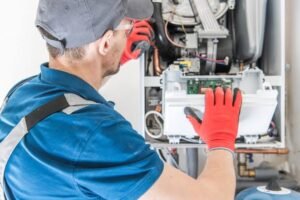
- A cracked or corroded heat exchanger. The heat exchanger is the metal barrier between the burning gas and the air blown into your rooms. It expands and contracts every cycle for fifteen or twenty years. When it splits, combustion products cross into the supply air and the blower distributes them through the house.
- Blocked or disconnected venting. The flue carries exhaust outside. A bird nest, a rodent nest, a crushed vent connector or a section that has separated at a joint sends that exhaust into the building instead. This is the failure most likely to appear suddenly after a long idle Modesto summer, when the system has sat unused since spring.
- Back-drafting. A furnace or water heater needs combustion air. When a tight house runs a powerful kitchen or bathroom exhaust fan, it can pull exhaust back down the flue instead of letting it rise. The appliance may be in perfect condition and still spill.
Warning signs that belong to this category rather than to the alarm: soot or dark staining around the furnace cabinet or the vent, a burner flame that is yellow and lazy rather than crisp and blue, unusual condensation on windows near the appliance, and a sharp or acrid smell when the system fires. Any one of them warrants a professional inspection even if the alarm has never sounded.
None of this is homeowner work. A heat exchanger crack is frequently invisible without the system running and the right instruments, back-drafting is diagnosed under operating conditions, and opening a burner compartment to look introduces its own hazards.
What are the symptoms of carbon monoxide exposure?
They escalate with concentration, and the EPA groups them by level. At low concentrations, fatigue in otherwise healthy people and chest pain in people with heart disease. At moderate concentrations, angina, impaired vision and reduced brain function. At higher concentrations, impaired vision and coordination, headaches, dizziness, confusion and nausea, and carbon monoxide is fatal at very high concentrations (EPA). The mechanism is carboxyhemoglobin forming in the blood, which blocks the blood’s ability to carry oxygen.
The single most useful clue for a household is one the EPA states directly: carbon monoxide can cause flu-like symptoms that clear up after leaving home. A winter illness that lifts when you go to work and returns in the evening is not behaving like an infection. If more than one person in the house has it at once, or if the family pet is lethargic too, that pattern deserves a same-day professional inspection rather than a wait-and-see.
Why does the alarm keep going off when nothing seems wrong?
Because a repeating, unexplained alarm is the normal signature of a genuine intermittent problem, not evidence of a faulty unit. This is the single most dangerous assumption people make, and it shows up constantly in homeowner forums: the alarm sounds, nobody feels ill, the alarm stops, and the household decides it must be a glitch.
Consider what actually produces that pattern. A marginal appliance spills only under certain conditions: when the exhaust fan runs, when the wind sits in a particular direction, when the system has been cycling for hours on the coldest night, or when a still, fog-damp Modesto morning holds exhaust close to the house instead of dispersing it. The level rises past the alarm threshold, the conditions change, and it falls again. An alarm doing its job looks exactly like an alarm behaving erratically.
Three practical checks after the building has been cleared by responders:
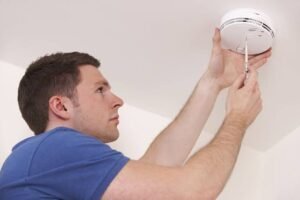
- Check the alarm’s age. Carbon monoxide sensors have a limited service life, commonly seven to ten years, and the manufacture date is printed on the back of the unit. An expired sensor can read high, low or erratically. Replace the unit rather than the battery.
- Check placement. Units mounted directly above or beside a fuel-burning appliance can pick up brief, normal start-up emissions. Follow the manufacturer’s instructions for distance and height.
- Have the combustion appliances tested under operating conditions. A technician measuring while the furnace runs through a full cycle can find a spill that leaves no trace when the system is cold.
Does California require carbon monoxide alarms?
Yes, and the requirement falls on the property owner. California Health and Safety Code section 17926 states that an owner of a dwelling unit intended for human occupancy “shall install a carbon monoxide device, approved and listed by the State Fire Marshal,” in each existing dwelling unit “having a fossil fuel burning heater or appliance, fireplace, or an attached garage” (California Legislative Information).
The deadlines are long past. Single-family dwelling units were covered on or before 1 July 2011, and all other existing dwelling units on or before 1 January 2013. On placement, the statute requires installation “in a manner consistent with building standards applicable to new construction for the relevant type of occupancy or with the manufacturer’s instructions.” A violation is an infraction carrying a maximum fine of $200 per offense, and a property owner must receive a 30-day notice to correct before that fine is assessed.
This matters for anyone renting. If an alarm activates and a landlord or building manager treats it as a nuisance, the obligation to provide a working, listed device is not a matter of opinion. Put the request in writing, keep a copy, and involve the local building or code enforcement office if it is ignored. If the alarm is sounding now, none of that changes the first step, which is to leave and call 911.
When should you call a heating professional?
After the emergency is over, and before the next cold night. Book a combustion inspection when any of these is true:
- A carbon monoxide alarm has activated at any point, even once, even if responders found nothing
- Household members have flu-like symptoms that improve away from the house
- You see soot, scorching or heavy rust around the furnace, the vent connector or the water heater
- The burner flame is yellow rather than blue, or it flutters when another appliance starts
- The heating system has not been inspected since before last winter
A proper inspection tests the appliance while it runs: heat exchanger examination, a carbon monoxide measurement at the appliance, a draft and venting check, and combustion air verification. If you need that inspection in Modesto, our furnace repair and diagnostic service covers it. For the wider winter picture, including how this fits with the other heating risks in a Modesto home, see the guide to winter home comfort, safety and energy costs.
If the heat has failed and you are tempted to improvise a heat source while you wait, read what counts as a true no-heat emergency first. Ovens, barbecues and generators used indoors are a recurring cause of poisoning, and a cold night is survivable in this climate in a way that carbon monoxide is not.
Frequently asked questions
What should I do when my carbon monoxide detector is going off?
Leave the building immediately with everyone in it, including pets, then call 911 from outside. Do not search for the source, do not open windows on your way out, and do not go back in until the fire service confirms it is clear. An alarm that falls silent on its own has not resolved anything.
Am I okay if the alarm went off but nobody feels ill?
You cannot judge that from inside the house, which is why the response is the same either way. Lower exposures cause fatigue and chest pain in people with heart conditions before more obvious symptoms appear, and carbon monoxide impairs judgment. Let responders measure the air, and get medical attention for anyone with symptoms.
Why does my carbon monoxide detector keep going off for no reason?
Repeated unexplained alarms are more often a genuine intermittent source than a faulty unit. Appliances spill under specific conditions such as an exhaust fan running, a long cold-night cycle, or particular wind. Check the unit’s age, since sensors typically last seven to ten years, check placement, and have the combustion appliances tested while running.
Can a gas furnace cause carbon monoxide?
Yes, through a cracked heat exchanger, blocked or disconnected venting, or back-drafting that pulls exhaust into the house. Around 64% of Modesto homes heat with gas, so the furnace is a realistic candidate here. A sound, correctly vented furnace sends its combustion products outdoors and is not a hazard.
What if my landlord or building manager ignores a carbon monoxide alarm?
California Health and Safety Code 17926 requires the owner of a dwelling unit with a fossil fuel burning appliance, fireplace or attached garage to install a State Fire Marshal approved carbon monoxide device. Make the request in writing, keep a copy, and contact local code enforcement if it is ignored. A violation is an infraction with a fine of up to $200 per offense.
How often should carbon monoxide alarms be replaced?
Replace the unit when it reaches the end of the service life printed on it, commonly seven to ten years from the manufacture date on the back. Test alarms monthly, replace batteries as the manufacturer directs, and replace the whole device when it gives an end-of-life warning, since a new battery will not restore an expired sensor.
The short version
An alarm sounding means leave and call 911 from outside, every time, with no exceptions and no diagnosis attempted indoors. An alarm that has sounded even once means a combustion inspection before the next cold night. And a winter illness that lifts whenever you leave the house is worth taking seriously, because that is the pattern carbon monoxide makes when the level is too low to trigger anything else.